
- 2026-09-19
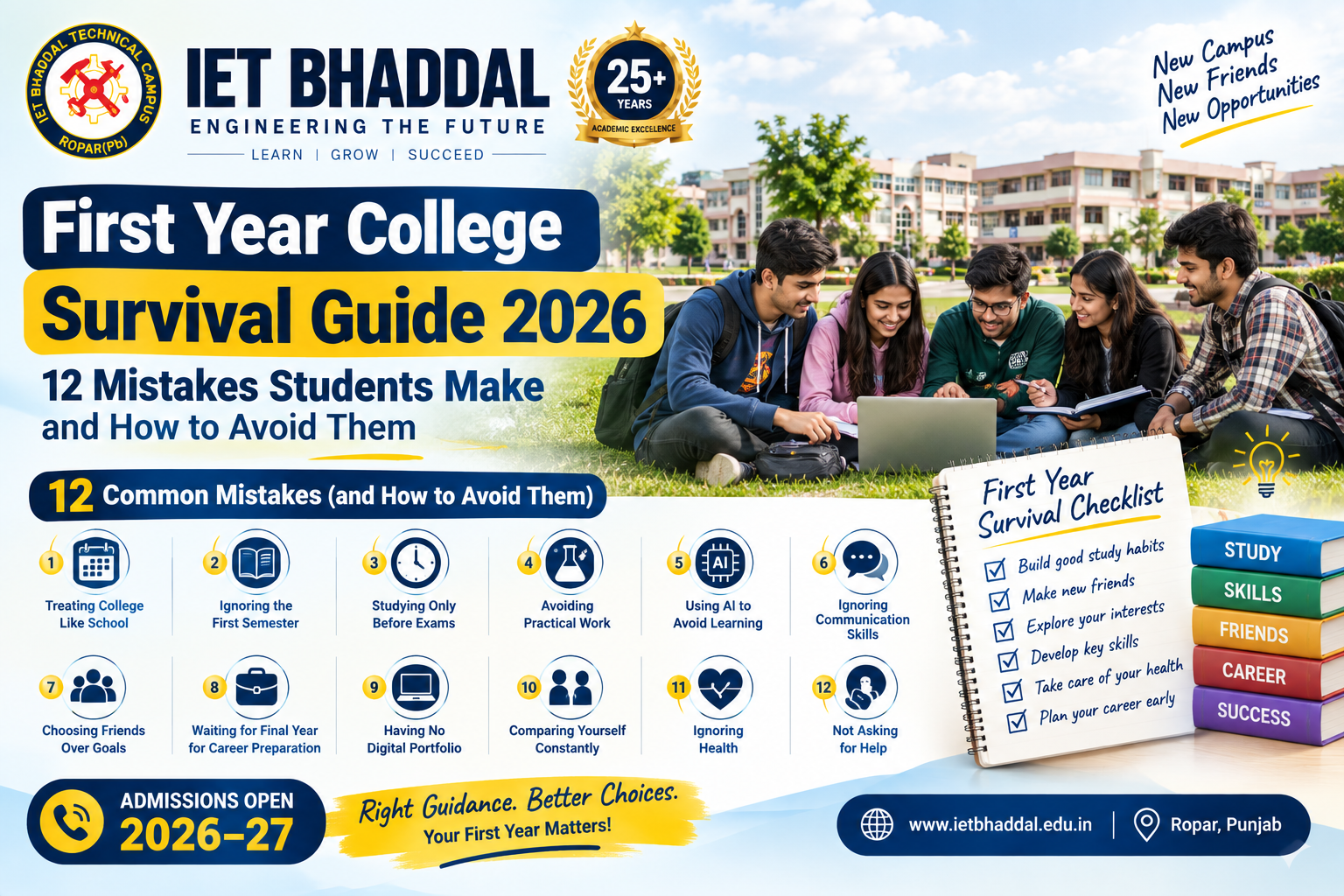
First Year College Survival Guide 2026 12 Mistakes Students Make and How to Avoid Them
Desc - Starting college in 2026? Learn 12 common first-year mistakes and practical ways to manage studies, friendships, technology, attendance, skills and career preparation.
First Year College Survival Guide 2026: 12 Mistakes Students Make and How to Avoid Them
Starting college sounds exciting: a new campus, new friends, new subjects and more independence. But the first year can also be confusing. Students who performed well in school sometimes struggle because college requires a different approach to learning.
You have more freedom, but also more responsibility. Whether you are starting B.Tech, BCA, BBA, B.Com, B.Pharmacy, B.Arch or another programme, the first year is the time to establish habits that can influence the rest of your academic journey.
Mistake 1: Treating College Like School
In school, teachers often remind students about homework, tests, projects and deadlines. College requires more self-management. Track assignments, attendance, exams, projects, presentations and practical work. Create a weekly schedule and spend 10 minutes every Sunday planning the week.
Mistake 2: Ignoring the First Semester
Some students think they will start seriously next semester. This can create unnecessary academic pressure. Your first semester helps establish your understanding of core subjects, technical concepts, academic expectations and study habits. Start early.
Mistake 3: Studying Only Before Exams
Last-minute studying may help you pass some exams, but it isn't a good strategy for technical subjects. Engineering and computer courses often build concepts progressively. Study in small sessions throughout the semester.
Mistake 4: Avoiding Practical Work
Don't become a student who knows definitions but cannot apply them. Programming students should write code; mechanical students should practise design; civil students should understand practical applications; electrical students should understand systems; BCA students should build applications.
Mistake 5: Using AI to Avoid Learning
AI tools can be useful, but there is a major difference between using AI to understand a concept and using AI to submit work you don't understand. Use AI to explain concepts, create examples, debug code, generate practice questions, improve writing and brainstorm ideas. Always verify and understand the final work.
Mistake 6: Ignoring Communication Skills
Technical knowledge is important, but students also need to communicate. Practise speaking, presentations, email writing, group discussions and interviews. You don't need perfect English; you need the confidence to communicate your ideas clearly.
Mistake 7: Choosing Friends Over Goals
Friends can make college enjoyable, but don't allow your social life to completely control your academic routine. Build friendships with people who encourage learning, growth, healthy activities and career development.
Mistake 8: Waiting Until Final Year for Career Preparation
Don't start thinking about internships and jobs only when graduation is approaching. Year 1: explore. Year 2: build skills. Year 3: intern. Final year: apply and prepare.
Mistake 9: Having No Digital Portfolio
Depending on your course, start documenting your work. Technology students can use GitHub and LinkedIn; architecture students can create a design portfolio; management students can document projects and case studies.
Mistake 10: Comparing Yourself Constantly
One student may learn coding quickly, another may be excellent at presentations and someone else may be good at design. College is not a race against classmates. Measure yourself against your previous performance.
Mistake 11: Ignoring Health
Students often sacrifice sleep, food, exercise and mental breaks during exam periods. Build basic habits: Sleep → Study → Move → Eat → Repeat.
Mistake 12: Not Asking for Help
If you don't understand something, ask. Talk to faculty, seniors, classmates or academic mentors. One unanswered question can become five difficult chapters later.
First-Year Survival Checklist
Use the checklist below to keep your first year balanced.
What Should B.Tech Students Do in First Year?
If you are pursuing engineering courses after 12th, focus on fundamentals. For CSE, build programming and problem-solving foundations. For Mechanical, understand engineering fundamentals and design. For Civil, strengthen drawing/design and practical understanding. For Electrical, build circuit and systems fundamentals.
What Should BCA Students Do?
BCA students should begin building programming, database knowledge, web fundamentals, computer applications and communication. This will make later subjects easier and prepare you for internships.
Your First-Year Rule
Don't try to become an expert in everything. Become consistent at learning. If you build that habit in Year 1, your later years become much easier.
How to Make Friends Without Losing Focus
The first few weeks of college can feel socially overwhelming. You do not need to become friends with everyone. Start by speaking to classmates during practical sessions, group projects, clubs and campus activities. Good friendships can make college more enjoyable, but your routine should not depend on whether your friends are studying. Keep your own schedule and learn to say no when you need focused study time.
How to Handle Attendance and Deadlines
Create one place where you record attendance requirements, assignment deadlines, internal assessments and practical submissions. Check it at the start and end of each week. Do not rely on WhatsApp messages or memory alone. If you miss a class, find out what was covered as soon as possible. Small administrative habits can prevent avoidable academic stress.
How to Find Your Learning Style
Some students learn best by reading, others by watching demonstrations, solving problems, writing explanations or teaching someone else. Test different approaches during your first semester. For technical subjects, combine explanations with actual problem-solving. For programming, type and test code yourself. For theory, use active recall and spaced revision. Your goal is not to find one perfect method but to discover what helps you retain information.
How to Use Your First Semester to Explore Careers
You do not need a fixed career plan on your first day. Use the semester to explore different roles connected with your course. Read job descriptions, attend talks, speak with seniors and try small projects. A CSE student may discover an interest in development or data; a BBA student may prefer marketing or finance; a mechanical student may enjoy design or manufacturing. Exploration is productive when it leads to informed choices.
A 30-Day First-Year Action Plan
Use your first month to build a simple routine rather than trying to change everything at once. During Week 1, understand your timetable, attendance expectations, subjects, faculty contacts and academic deadlines. Create one calendar for everything related to college. During Week 2, choose one technical or subject-related skill and spend a few focused sessions practising it. During Week 3, speak with at least one senior or faculty member about projects, competitions, internships and useful resources. During Week 4, review your first month and identify what is working and what needs to change.
A useful weekly routine can include one session for reviewing class notes, two sessions for practical or technical practice, one session for communication or presentation practice, one session for career exploration and one longer session for completing assignments. The exact schedule will depend on your course and timetable, but the principle is to create regular habits before academic pressure increases.
Students should also learn to manage their digital distractions. Turn off unnecessary notifications during study sessions, keep social media away from the study desk and use app limits if needed. Your phone can be a useful learning device, but it can also become the biggest source of lost study time. Decide in advance when you will use it for learning and when you will use it for entertainment.
Finally, remember that the first year is not a competition. You do not need to have your entire career planned immediately. Your goal is to understand your course, build fundamentals, discover your interests and develop habits that make future learning easier. A student who consistently improves a little every week can finish college with a much stronger foundation than someone who tries to learn everything during the final semester.
Quick Reference Table
|
Area |
First-Year Goal |
|
Academics |
Build strong fundamentals |
|
Technical skills |
Learn one useful skill |
|
Communication |
Practise regularly |
|
Projects |
Complete one meaningful project |
|
Networking |
Connect with classmates/faculty |
|
Career |
Explore possible career paths |
|
Health |
Maintain basic routine |
|
Digital presence |
Start LinkedIn/portfolio |
|
Internships |
Research opportunities |
Frequently Asked Questions
Is first year really important?
Yes. It establishes your academic foundation, study habits and approach to college.
How many hours should I study?
There is no universal number. Focus on consistent daily study rather than a fixed number of hours.
Should first-year students learn AI?
Basic AI literacy can be useful, but students should first build strong fundamentals in their main subject.
Should I start internships in first year?
You can explore opportunities, but first year should primarily focus on building fundamentals and understanding your field.
What should I do if I fall behind?
Identify the specific topics you missed, speak with faculty or classmates and create a recovery schedule instead of waiting for exams.
Suggested Closing CTA
Choosing the right academic path is an important decision. Explore the relevant course, understand your options, build practical skills and choose an environment that supports your long-term goals.
Explore programmes and admission information at IET Bhaddal Technical Campus, Ropar, Punjab.
www.ietbhaddal.edu.in