
- 2026-07-09
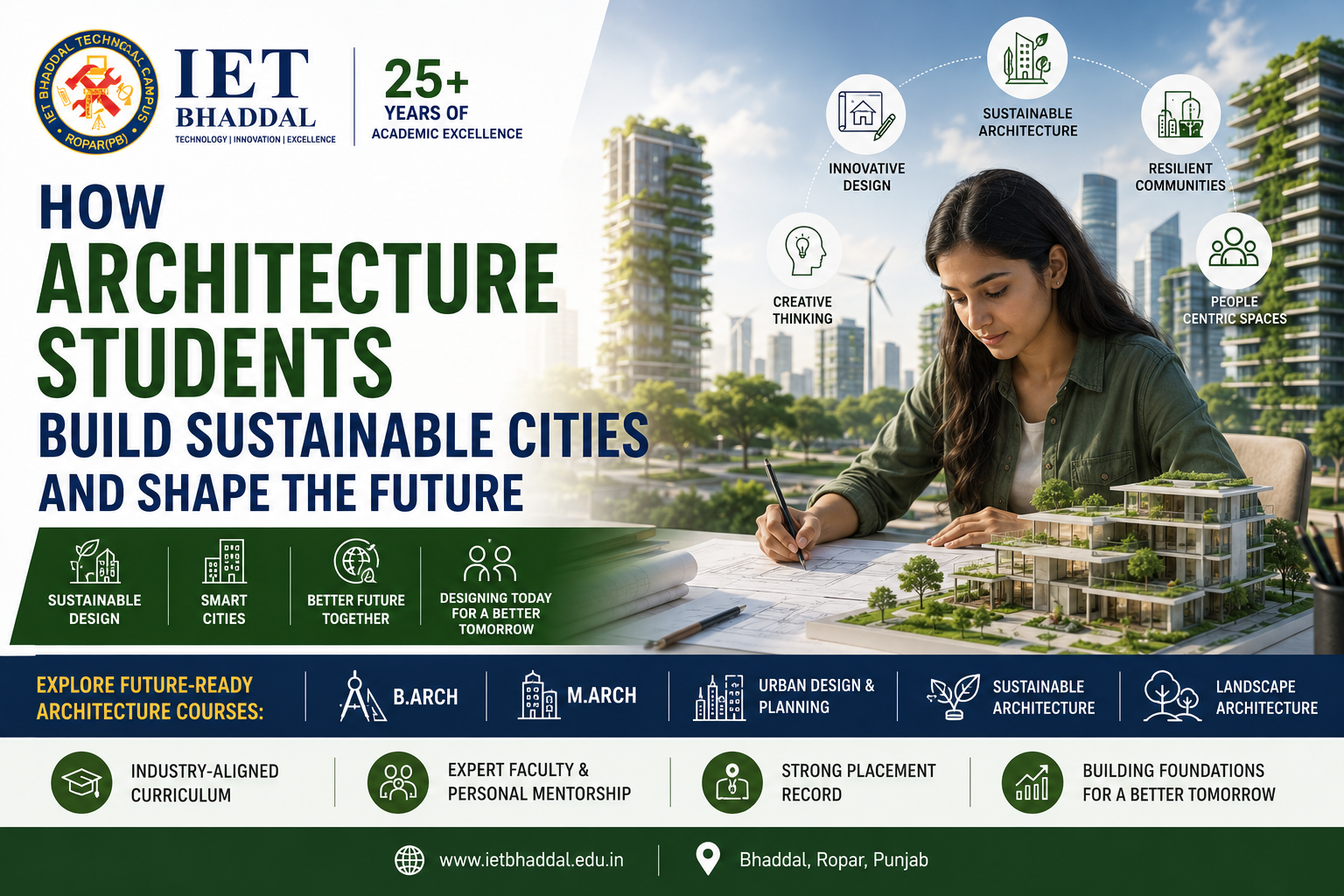
How Architecture Shapes the Future
Desc - Discover how architecture students solve real-world challenges through sustainable design, smart cities, and innovation. Explore the future of architecture and B.Arch admissions 2026 at IET Bhaddal.
How Architecture Students Build Sustainable Cities and Shape the Future
Every building tells a story.
Whether it's a school where children learn, a hospital that saves lives, or a public park where families spend time together, every structure begins with a simple question: How can this space improve people's lives?
The answer comes from architects, professionals who combine creativity, technology, engineering, and environmental awareness to design spaces that are functional, beautiful, and sustainable.
Today, architecture is no longer limited to designing houses or commercial buildings. Architects are helping create smart cities, eco-friendly communities, resilient infrastructure, and innovative public spaces that meet the needs of a rapidly changing world.
If you're considering an architecture course after 12th, this is the perfect time to explore a profession that offers creativity, innovation, and the opportunity to make a meaningful impact on society.
Why Architecture Matters More Than Ever
India is growing at an incredible pace. New residential townships, airports, highways, hospitals, educational institutions, metro networks, and commercial developments are transforming cities across the country.
However, this growth also brings challenges such as:
-
Increasing urban population
-
Climate change
-
Traffic congestion
-
Water scarcity
-
Rising energy consumption
-
Sustainable infrastructure requirements
Architects play an essential role in addressing these issues by designing spaces that improve efficiency, safety, and quality of life.
The future of architecture in India is closely linked with sustainable development, smart infrastructure, and technological innovation, making it one of the most promising career choices for students today.
Architecture Is About Solving Real-Life Problems
Many students believe architecture is mainly about drawing building plans. In reality, architects solve practical challenges that affect people every day.
Designing Sustainable Buildings
Modern buildings are expected to consume less energy while providing greater comfort.
Through sustainable architecture, architects learn how to:
-
Maximize natural lighting
-
Improve cross ventilation
-
Reduce electricity consumption
-
Harvest rainwater
-
Use eco-friendly construction materials
-
Minimize environmental impact
These practices not only protect the environment but also reduce long-term maintenance costs for building owners.
Building Safer Communities
Different regions have unique construction challenges.
For example, buildings in hilly regions require careful planning to withstand earthquakes and varying climatic conditions.
Architecture students study structural systems, construction techniques, building materials, and safety standards to create stronger and more resilient structures.
Designing Smarter Cities
As urban areas continue to expand, cities need better planning rather than simply adding more buildings.
This is where smart city architecture becomes important.
Architects contribute by designing:
-
Walkable neighbourhoods
-
Public transportation hubs
-
Mixed-use developments
-
Green public spaces
-
Sustainable residential communities
-
Smart infrastructure
Their work helps create cities that are safer, more efficient, and environmentally responsible.
Technology Is Transforming Architecture
Architecture has become one of the most technology-driven professions.
Today's architects use advanced digital tools to visualize ideas, improve collaboration, and reduce construction errors.
Some commonly used technologies include:
-
AutoCAD
-
Revit
-
SketchUp
-
Building Information Modeling (BIM)
-
3D Rendering
-
Virtual Reality (VR)
-
AI-assisted Design
These technologies help students prepare for the modern architecture and construction industry.
Skills Every Architecture Student Develops
A Bachelor of Architecture helps students build technical knowledge alongside essential professional skills.
During the programme, students develop:
-
Creative thinking
-
Design visualization
-
Problem-solving ability
-
Technical drawing
-
Communication skills
-
Project management
-
Team collaboration
-
Environmental awareness
-
Digital design expertise
-
Research and analytical thinking
These skills remain valuable across architecture, urban planning, construction, real estate, and interior design industries.
Learning Beyond the Classroom
Architecture is best learned through practical experience.
Instead of focusing only on textbooks, students spend significant time working on live projects, creating models, presenting ideas, and participating in design studios.
At IET Bhaddal Technical Campus, the Department of Architecture encourages practical learning through well-equipped facilities such as:
-
Spacious Design Studios
-
Computer Laboratories
-
Climatology Laboratory
-
Model Making Room
-
Surveying & Leveling Laboratory
-
Material Testing Laboratory
-
Carpentry Workshop
-
Art Room
-
NASA Resource Centre
These facilities help students transform creative concepts into practical architectural solutions while developing industry-relevant skills.
Students looking for an architecture college in Ropar often value this combination of academic learning and hands-on experience.
Why Students Prefer Studying Near Chandigarh
The Chandigarh region has become an educational hub for aspiring architects because of its planned urban development, growing infrastructure, and proximity to leading architecture and construction firms.
Many students from Punjab, Haryana, and Himachal Pradesh choose institutions in this region to benefit from industry exposure, internships, and modern learning facilities.
If you are searching for an architecture college near Himachal Pradesh or comparing architecture colleges near Mohali, choosing a campus that emphasizes practical education and design innovation can make a significant difference to your career.
Among the architecture colleges in Punjab, IET Bhaddal Technical Campus offers a learning environment where creativity, technical knowledge, and practical application go hand in hand.
Career Opportunities After B.Arch
Architecture graduates have opportunities across diverse industries.
Some popular career paths include:
-
Architect
-
Urban Planner
-
Landscape Architect
-
Interior Designer
-
Sustainable Design Consultant
-
BIM Specialist
-
Heritage Conservation Architect
-
Project Architect
-
Construction Consultant
-
Real Estate Planner
Many graduates also pursue postgraduate studies or establish their own architectural practices.
As infrastructure investment and sustainable construction continue to grow, demand for skilled architects is expected to remain strong.
Why Choosing the Right Architecture College Matters
Selecting the right institution is one of the most important decisions for an aspiring architect.
While comparing the best architecture college near Chandigarh, students should look beyond rankings and consider factors such as:
-
Council of Architecture (CoA) approval
-
Experienced faculty
-
Studio-based learning
-
Modern laboratories
-
Industry exposure
-
Internship opportunities
-
Campus infrastructure
-
Placement support
A strong learning environment helps students build confidence, technical expertise, and creative thinking throughout their academic journey.
If you're planning your B.Arch admission 2026, visiting the campus, interacting with faculty members, and exploring the available facilities can help you make an informed decision.
Frequently Asked Questions (FAQs)
1. Is architecture a good career after Class 12?
Yes. Architecture is an excellent career for students interested in creativity, technology, engineering, and problem-solving. It offers opportunities across construction, urban planning, interior design, sustainable development, and infrastructure projects.
2. What is the duration of a B.Arch programme?
A Bachelor of Architecture (B.Arch) is typically a five-year undergraduate programme that combines classroom learning with practical studio work, internships, and project-based education.
3. What skills are important for architecture students?
Successful architecture students usually possess creativity, observation skills, analytical thinking, communication abilities, problem-solving skills, and an interest in design and construction.
4. Why is practical learning important in architecture?
Architecture is a hands-on profession. Design studios, model making, site visits, software training, and workshops help students apply theoretical knowledge to real-world projects and develop industry-ready skills.
5. How is sustainable architecture shaping the future?
Sustainable architecture focuses on designing buildings that reduce energy consumption, conserve water, use environmentally friendly materials, and improve overall environmental performance. It is becoming an essential part of modern construction worldwide.
6. What career opportunities are available after completing B.Arch?
Graduates can work as architects, urban planners, landscape architects, interior designers, BIM specialists, sustainable design consultants, project architects, heritage conservation experts, and construction consultants.
7. Why should students consider studying architecture near Chandigarh?
The region offers excellent educational institutions, access to modern infrastructure projects, internship opportunities, and exposure to the growing architecture and construction industry, making it an attractive destination for aspiring architects.
Conclusion
Architecture is much more than designing attractive buildings—it's about creating spaces that improve lives, strengthen communities, and support a sustainable future. Every project challenges architects to think creatively, solve practical problems, and balance innovation with functionality.
As India continues to invest in smart cities, green infrastructure, and modern urban development, the demand for skilled architects is expected to grow. For students who enjoy creativity, technology, and problem-solving, a Bachelor of Architecture offers a career that is both professionally rewarding and socially meaningful.
If you're exploring the best architecture college in Punjab or looking for a B.Arch college near Chandigarh, focus on institutions that offer practical learning, experienced faculty, modern design studios, and industry exposure. At IET Bhaddal Technical Campus, students learn through studio-based education, advanced laboratories, workshops, and real-world design experiences that prepare them for the evolving architecture profession.
Whether your goal is to design sustainable homes, contribute to smart city projects, or preserve India's architectural heritage, the journey begins with the right education. A strong foundation today can help you shape the skylines and communities of tomorrow.